
Social workers should be viewed as extremely valuable employees as far as local communities and society in general are concerned. A social worker is responsible for working with people of all ages who are in some way socially excluded, vulnerable or undergoing some level of crisis.
A Social Worker's Role
The role and duties of a social worker are broad and varied, but generally include the provision of guidance and support, in order to enable service users (the people they help) to eventually support themselves as much as possible. Social workers are employed in a variety of environments, with some working in schools, local education authorities and hospitals, and others working within voluntary organisations or in an individual's own home.
Social work can be a stressful career, you need to be well organised as there is a significant level of administrative work - and time management skills are crucial. A social worker is expected to assess, review and maintain records of specific cases, all within certain timeframes whilst achieving set standards of care and providing service users and their families with the help they need.
Personality Types
The ideal social worker will be caring by nature, with an ability to empathise and communicate with those around them, particularly those who may be hard to deal with, such as the vulnerable and disaffected in society. You'll need to be fairly tough to cope with all this and you will also be up against many other organisations in trying to achieve the necessary help for those you are supporting.
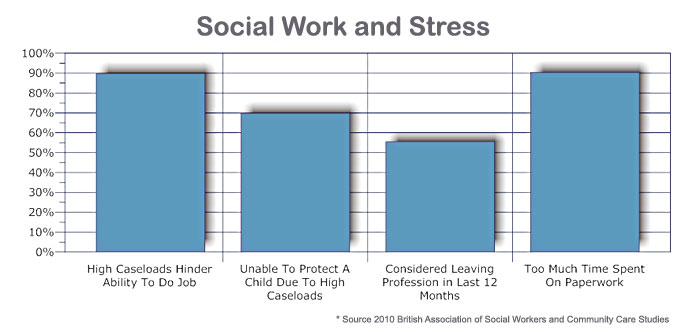
Studies undertaken by the British Association of Social Workers illustrate the high caseloads and stress levels experienced by many social workers. Here's what they found:
What Qualifications Do I Need?
To become a social worker, you will need a social work degree. The degree course takes 3 years to complete in England, Wales and Northern Ireland - and 4 years in Scotland. Before being accepted onto a social work degree course, you will need to demonstrate that you understand what social work is about and have had some kind of experience in social work or social care.
Your previous experience could be paid work experience in a related field such as a carer or it could be voluntary experience within a care or social work setting. It will help you to assess your own strengths and weaknesses, as well as providing an understanding of just what sort of work is involved in a career as a social worker.
Demand for social work degree places is extremely high so the better your grades and the quality of your relevant experience, the more chance you will have of gaining a place. To get a place on a social work degree course in England you will need:
- A minimum of 5 GCSE's at grade A* to C - two of these MUST be English and Maths
- You will also need a minimum of 2 A levels
In Scotland, you will need at least 4 Highers and in Northern Ireland a minimum of 3 B-Grade A-levels.
Can I Study While I am Working?
If you do not want to give up your paid job, you can undertake the social work degree on a part time basis. You will still need:
- To have the relevant entry requirements
- To complete all the modules within the course
- To be able to complete the 200 day practice placement
The previous qualifications necessary to become a social worker were the Certificate in Social Service (CSS), the Certificate of Qualification in Social Work (CQSW) and Diploma in Social Work (DipSW). These are still recognised qualifications for those returning to the workplace, but all new social work students will now need to undertake the academic degree with integrated work placements.
Is There Much Demand for Social Workers?
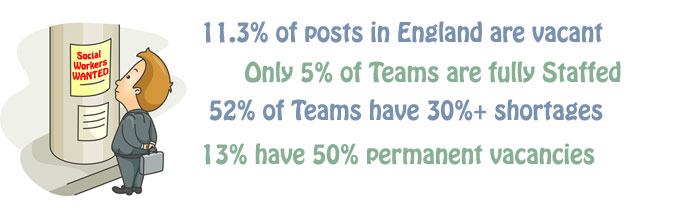
Whilst periodic public sector cuts will impact spending on social services, there will always be a need for social workers. Many charities, particularly those involved with protecting children, the elderly and the vulnerable, also employ qualified social workers. The BASW study of 2010 demonstrated the shortage of social work staff:
Transferable Skills
If you're already in a career, there are some Transferable Skills that you could you can draw on as a social worker:
- Problem-solving skills
- Communication (particularly listening) skills
- Organisational and time-management skills
- Mediation skills
Knowledge and understanding of the law and legal procedures will be important as a social worker and while this will be covered in training, any previous experience will be a bonus. Bear in mind that whatever skills you have, you will still need to complete the academic course and placements.
Society Sectors that Social Workers Help
Social workers can be brought in to help find support for many difference sectors of society. Typically they deal with:
- The elderly particularly those who are becoming vulnerable through dementia or frailty
- Vulnerable children/children at risk
- Children with disabilities and adults with learning disabilities
- Teenagers with mental health problems
- Young offenders
- People with alcohol or other addictions
- Refugees and asylum seekers
- Socially excluded people
Career Development and Salary
As you progress through your career you will receive ongoing training. All social workers in the UK, register with the Care Council and will need to re-register with them every 3 years, completing any necessary re-registration training in order to do so. Career development in social work tends to veer towards developing a specialism, for instance working with the elderly, in the foster care system, or with drug abusers etc. Through additional training there are also opportunities to enter more managerial and team leader positions, or even as a teacher, lecturer or political consultant.
A social worker's salary will depend on experience and qualifications. Generally however, a social worker can earn from £20,000 up to £40,000. Management roles will earn you up to £60,000, with senior management roles earning beyond £70,000 for a 37 hour week.
Working in social care can be extremely challenging, stressful and heavy workloads are common. However often the emotional rewards and contributions made to individuals, communities and society can outweigh the stresses and strains.
The Next Step?
The idea of returning to study or training to become a social worker (especially if it's a while since you left college), can be daunting at first, but you can do it! Have a look through Returning to University to find out what is involved.


Your email won't be published. Comments are moderated before appearing.