By: Lucy Debenham BA (hons) - Updated: 31 May 2020|*Discuss
Social workers should be viewed as extremely valuable employees as far as local communities and society in general are concerned. A social worker is responsible for working with people of all ages who are in some way socially excluded, vulnerable or undergoing some level of crisis.
A Social Worker's Role
The role and duties of a social worker are broad and varied, but generally include the provision of guidance and support, in order to enable service users (the people they help) to eventually support themselves as much as possible. Social workers are employed in a variety of environments, with some working in schools, local education authorities and hospitals, and others working within voluntary organisations or in an individual's own home.
Social work can be a stressful career, you need to be well organised as there is a significant level of administrative work - and time management skills are crucial. A social worker is expected to assess, review and maintain records of specific cases, all within certain timeframes whilst achieving set standards of care and providing service users and their families with the help they need.
Personality Types
The ideal social worker will be caring by nature, with an ability to empathise and communicate with those around them, particularly those who may be hard to deal with, such as the vulnerable and disaffected in society. You'll need to be fairly tough to cope with all this and you will also be up against many other organisations in trying to achieve the necessary help for those you are supporting.
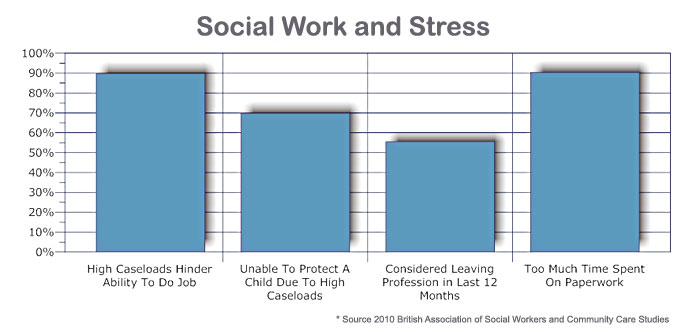
Studies undertaken by the British Association of Social Workers illustrate the high caseloads and stress levels experienced by many social workers. Here's what they found:
What Qualifications Do I Need?
To become a social worker, you will need a social work degree. The degree course takes 3 years to complete in England, Wales and Northern Ireland - and 4 years in Scotland. Before being accepted onto a social work degree course, you will need to demonstrate that you understand what social work is about and have had some kind of experience in social work or social care.
Your previous experience could be paid work experience in a related field such as a carer or it could be voluntary experience within a care or social work setting. It will help you to assess your own strengths and weaknesses, as well as providing an understanding of just what sort of work is involved in a career as a social worker.
Demand for social work degree places is extremely high so the better your grades and the quality of your relevant experience, the more chance you will have of gaining a place. To get a place on a social work degree course in England you will need:
A minimum of 5 GCSE's at grade A* to C - two of these MUST be English and Maths
You will also need a minimum of 2 A levels
At some universities this requirement can be higher. You will need to check the requirements at the university of your choice.
In Scotland, you will need at least 4 Highers and in Northern Ireland a minimum of 3 B-Grade A-levels.
Can I Study While I am Working?
If you do not want to give up your paid job, you can undertake the social work degree on a part time basis. You will still need:
To have the relevant entry requirements
To complete all the modules within the course
To be able to complete the 200 day practice placement
The previous qualifications necessary to become a social worker were the Certificate in Social Service (CSS), the Certificate of Qualification in Social Work (CQSW) and Diploma in Social Work (DipSW). These are still recognised qualifications for those returning to the workplace, but all new social work students will now need to undertake the academic degree with integrated work placements.
Is There Much Demand for Social Workers?
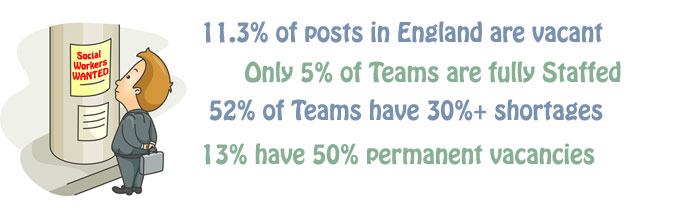
Whilst periodic public sector cuts will impact spending on social services, there will always be a need for social workers. Many charities, particularly those involved with protecting children, the elderly and the vulnerable, also employ qualified social workers. The BASW study of 2010 demonstrated the shortage of social work staff:
Transferable Skills
If you're already in a career, there are some Transferable Skills that you could you can draw on as a social worker:
Problem-solving skills
Communication (particularly listening) skills
Organisational and time-management skills
Mediation skills
Knowledge and understanding of the law and legal procedures will be important as a social worker and while this will be covered in training, any previous experience will be a bonus. Bear in mind that whatever skills you have, you will still need to complete the academic course and placements.
Society Sectors that Social Workers Help
Social workers can be brought in to help find support for many difference sectors of society. Typically they deal with:
The elderly particularly those who are becoming vulnerable through dementia or frailty
Vulnerable children/children at risk
Children with disabilities and adults with learning disabilities
Teenagers with mental health problems
Young offenders
People with alcohol or other addictions
Refugees and asylum seekers
Socially excluded people
Career Development and Salary
As you progress through your career you will receive ongoing training. All social workers in the UK, register with the Care Council and will need to re-register with them every 3 years, completing any necessary re-registration training in order to do so. Career development in social work tends to veer towards developing a specialism, for instance working with the elderly, in the foster care system, or with drug abusers etc. Through additional training there are also opportunities to enter more managerial and team leader positions, or even as a teacher, lecturer or political consultant.
A social worker's salary will depend on experience and qualifications. Generally however, a social worker can earn from £20,000 up to £40,000. Management roles will earn you up to £60,000, with senior management roles earning beyond £70,000 for a 37 hour week.
Working in social care can be extremely challenging, stressful and heavy workloads are common. However often the emotional rewards and contributions made to individuals, communities and society can outweigh the stresses and strains.
The Next Step?
The idea of returning to study or training to become a social worker (especially if it's a while since you left college), can be daunting at first, but you can do it! Have a look through Returning to University to find out what is involved.
Related Articles in the 'Caring & Education' Category...
Hello. I have worked in Adult Social Carr all my adult life after studying Social Policy at university. For the last 12 years I have worked for a local authority in an adult social care team - working as an unqualified social worker. We do the the same job but without the qualification. I am experienced in my job and there are so many aspects of the job I really enjoy, but I need a change. I know I don’t want to do the social work MA - I found my degree hard and it’s not something I want to go through again. I am struggling to find jobs that I feel I can demonstrate experience and transferable skills but that would match my current salary. My job is tough and you have to bea tough, resilient and determined person. It is essential to be able to communicate with different types of people, accurately record what is happening and be non judgemental. I know I have many skills I could transfer ... but to what?
I have so many day dreams about different professions but in reality I need a secure job I can be good at. Where do I start?
For those wanting a career in Social Work I highly recommend finding an unqualified position with your local authority as it will help you understand the job but also give you the opportunity to study to be a qualified social worker whilst also being employed. Yes you are in a position to help and empower vulnerable people, by there are also many budget constraints, which are making it all much harder.
Thanks
Sophie
Barkerelli - 31-May @ 8:23 PM
Hi
Thinking about totally changing career path and becoming a social worker. I currently have an hnc in business administration with travel tourism. Would this be enough to possibly get me on the ladder to return to studying.
Sunnygill19 - 21-Sep @ 5:52 PM
Hi! I’ve been a primary school teacher for 21 years (BEd Primary Studies 2:1) and have always had a burning desire to train/work as a social worker. Can you tell me how I could go about this?
Thanks!
Abbyf38 - 9-Aug @ 11:16 AM
I have B.A (Hons) in SocialWelfare Law, Advice, Practice and Guidance. How do I get to be a social worker. I got a 2:1 and three marks off a first. Thank you Neil
Neilo - 29-Jul @ 6:33 PM
I have spent the last 17 years as a social carer, and have gained an NVQ level 2 in care and social care, and now just starting a diploma level 3. What else will I need to become a social worker.
Sue - 16-May @ 11:37 AM
I am currently studying a HND in healthcare practice. I hope to go to university to top up my degree. This will result in me having a BSc in Health Studies. Will this be acceptable to become a social worker?
Lucy - 2-May @ 9:05 PM
Hi there, I have a HNC in hairdressing which I finished two years ago is this enough to get me in or what else will I need?? Thanks
Shell - 29-Apr @ 2:41 PM
I would love to startstudying to be a social worker . I am a mother of 7 children . Been hpusewife for many years and i have done alot of training courses in special needs . Mentalhealth counsellingto help my family and other people out there . I believe i have all empathy compassion and knowledge to help many otgers . I have got 9 gcses years ago . What do i have to do to become a social worker . Please advise me x
Bav - 21-Mar @ 2:14 PM
Hi,
I am nearing the end of an Open University Health and Social Care Degree. I havea Level 7 qualification for teaching and Assessing as well. I have worked in education for 18 yearsand have volunteered for Home Start and at a local older persons day centre. Can you please advise what the next step would be towards becoming an older persons social worker?
Reds - 28-Jan @ 12:54 PM
Hi, I have looked at Frontline and Step-Up To Social Work. I looked at the 2:1 requirement and the Q&A on this. I got a 2:2 at art college in 1982. The answer to 'does a Masters count as a 2:1?' was 'no'. I have asked their help section whether my PhD, MA in Education and International Development (with distinction), and 30 years of experience in Child Protection in international contexts would trump the 2:1 line they have drawn. Unfortunately, they have not answered my inquiry. Would you be able to help here?
Tim - 7-Jul @ 11:07 AM
Charlie D - Your Question:
I have a 2.2 bachelor of Arts degree, post graduate diploma and level 5 in management health and social care.I have over 10 years of practical and relevant experience to draw on plus lots of transferable skills.the only thing I don't have is Math's GCSE are there any uni's in the Uk who will accept a mature student on a masters course in social worker without Math's GCSE?
Our Response:
We really don't know. The easiest way to find out is to contact individual institutions. They may also provide you with some suggestions for ways to get round this, or to fast track yourself through a GCSE course/similar maths qualification.
ACareerChange - 22-Jun @ 2:45 PM
I have a 2.2 bachelor of Arts degree, post graduate diploma and level 5 in management health and social care...I have over 10 years of practical and relevant experience to draw on plus lots of transferable skills....the only thing I don't have is Math's GCSE are there any uni's in the Uk who will accept a mature student on a masters course in social worker without Math's GCSE?
Charlie D - 21-Jun @ 8:09 PM
I am currently a deputy manager in a nursery. Having my level 3 in childcare, leadership qualification and currently completing management course. I have worked with children who have mild aspects of behavioural issues and this has stirred me onto wanting to become a social worker. What would be my next course to take to further myself to the career I want.
Gem - 10-Jun @ 9:49 PM
Hi, I have a 2:2 BA honours degree in early years and childhood studies. Am I able to apply for the stepping up to social work course or does this require a 2:1?
What options would I have?
LS - 8-May @ 4:49 PM
Hi,
I completed my NC in Social Care in 2007.
Completed my HNC SC 2010.
I got an A for my graded unit,Just wondering if this is still accepted at many universities? Stirling university, at that time allowed students who got an A for there GU straight too year 2?It may be too long a gap tho have done care since..
Thanx
Ml - 28-Feb @ 8:41 PM
Ffi- Your Question:
I have qcf level 5 in management health and social care, as well as 7 years experience running a 7000 hour a week domicilary care agency as a registered manager would this be deemed the equifilient qualification to become a social worker ?
Our Response:
It may get you on to a social work degree course which requires about 120 UCAs points. You could also try the open university or on-the-job social work training provider Frontline
ACareerChange - 21-Feb @ 2:25 PM
I have qcf level 5 in management health and social care, as well as 7 years experience running a 7000 hour a week domicilary care agency as a registered manager would this be deemed the equifilient qualification to become a social worker ?
Ffi - 20-Feb @ 8:16 PM
123 - Your Question:
Hiya, I need help I want to be a social worker and have not chosen my GCSE options yet and therefore have not yet made any permanent choices. Is there any way you could please run my through the steps I need to take and options I need to choose thank a lot for your time
Our Response:
When you choose your GCSEs, not that a social work degree requires aminimum of 5 GCSEs A-C, including maths, English and science, and two A levels. At A level, there is no specific subjects requirement but if you check UCAS and the British Association of Social Workers etc, you may find certain A levels are more relevant than others.
ACareerChange - 12-Feb @ 1:53 PM
Hiya, I need help
I want to be a social worker and have not chosen my GCSE options yet and therefore have not yet made any permanent choices. Is there any way you could please run my through the steps I need to take and options I need to choose thank a lot for your time
123 - 9-Feb @ 9:26 PM
Niamh.C - Your Question:
Hi, I’m currently looking to start an apprenticeship as a nursery nurse but would like to be a social worker at some point. Would any qualifications I gain as a nursery nurse help me become a social worker?
Our Response:
Some NVQ type qualifications at level 3 or above might qualify you for entry on to a social work degree course. These could include heath, social care, childcare & education etc
ACareerChange - 29-Jan @ 11:28 AM
Hi,
I’m currently looking to start an apprenticeship as a nursery nurse but would like to be a social worker at some point. Would any qualifications I gain as a nursery nurse help me become a social worker?
Niamh.C - 26-Jan @ 3:59 PM
Hi I have a BA in drama, applied theatre and education, I am currently a mum of 2 and TA, and want to. Become a social worker, is there another path I could take instead of doing another degree as I am not in a financial position to go back into full time education. Thank you
Lucy - 5-Jan @ 9:36 PM
LA - Your Question:
I am about to be made redundant from a 13 year career in the criminal justice field. This includes both frontline work and within learning and development. I have a CertEd and a higher cert in criminal justice. I am considering a career in social work. What would I need to do
I am about to be made redundant from a 13 year career in the criminal justice field. This includes both frontline work and within learning and development. I have a CertEd and a higher cert in criminal justice. I am considering a career in social work. What would i need to do
LA - 27-Nov @ 10:15 PM
Tiffany ridley - Your Question:
Hi im currently a mobile hairdresser age 28 have been hairdressing for nearly 15 years, ive also been a carer for my mum since I was 11 years old. I feel as though I would love to become a socail worker, having experienced them in my personal life and how much amazing help they have been for me they have inspired me to change career , im good with people but my qualifications arent uo to scratch I uave a few nvqs and vctc but in hair and makeup and my gcse are terrible. where do I start?thankyoutiffany
Our Response:
You would need to start with at least some academic qualifications, ask at your local college to see what part time A level or relevant NVQ level 3 courses are available. Once you've completed these you can look at the various ways to become a social worker.
ACareerChange - 30-Oct @ 1:55 PM
hi
im currently a mobile hairdresser age 28 have been hairdressing for nearly 15 years, ive also been a carer for my mum since i was 11 years old . i feel as though i would love to become a socail worker, having experienced them in my personal life and how much amazing help they have been for me they have inspired me to change career , im good with people but my qualifications arent uo to scratchi uave a few nvqs and vctc but in hair and makeup and my gcse are terrible ... where do i start?
thankyou
tiffany
Tiffany ridley - 28-Oct @ 3:00 AM
Just like kaptaink, based on their comments pasted below, I have several months of support worker experience in mental healthcare among other public and private sectors experiences, and would really love a total career switch to social work, subject to being accepted on an MSc/MA SW course. I have a non-social work 2:2undergraduate awarded in 1998 plus a 2008-awarded master's (both humanities based and didn't need a GCSE grade C Maths to be accepted, which I don't have anyway). Kaptaink, could you please be a bit more specific about the Russell group University that accepted you on the MSc SW course? I would also welcome from all - any advice on similar universities that could consider me or on other options available. Thanks.
Kaptaink's Comments:
'to everyone posting here who got a 2:2 in their undergraduate degree and have been put off applying for a Master's - don't be. I took a 2:2 for a degree in an unassociated field (an arts degree) and didn't have maths at GCSE either but I got a place at a Russell group University on a MSc SW course. The deciding factor was my work experience which was eighteen months as a support worker with a community mental health team. Alongside this I wrote a good application, had good references and gave a good interview and now I'm a qualified social worker. Don't write yourself off because you have a 2:2 - if you've got what it takes and have a degree in any subject and of any class you should be able to find yourself a place on a suitable course. Getting funding is more likely to be the real challenge these days'.
Ose - 19-Oct @ 7:09 PM
Hi,
I am finishing my BA Open Degree at the Open University whereas the 3rd year is created from 2 modules from Social and Health Care degree (Working Together for Children and Approaches to Mental Health). I would like to become a qualified Social Worker however, I can't afford to study full time. Furthermore, I've been working in school settings both in Primary and Secondary and would appreciate to continue working with children. Could you please kindly advice me what path I should follow considering I've got 120 credits at level 6 (England) from Health and Social Care degree? Thank you very much for your answer.
Yours sincerely,
LS
LeShep - 26-Sep @ 7:44 PM
Hi, any universities still offering the option of a further year of study converting the DipSW into a degree-level qualification? Thanks!
Wong - 7-Aug @ 10:17 AM
Beth-Louise - Your Question:
Hello, I wonder if someone could answer my question. I have 20 years experience in Early Years and am an Assistant Manager in a setting. I have just received a 2:1 in a (BA) hons degree in education. But, am interested in becoming a Social Worker. What extra qualification would I require, please?
Our Response:
You would normally need to take an additional social work qualification such as a degree in social work. There are some programmes like Frontline where you can qualify on the job - you will need a minimum of a 2:1 in your undergraduate degree.
Goth girl Re: Becoming a Paramedic
I would love to become the first aider and paramedic for working in the ambulance as the career in doing that role for me
1 August 2024
MegVark Re: Finding Work Experience as an Adult
Hi. I have spent the majority of my career as a HCA. I was very good at it but last year I had an operation that left me…
26 June 2024
Lynch Re: How to Become an Insurance Broker
So I have a lot people that want life insurance how do I become a insurance broker or even help someone by passing these…
26 May 2024
Sam Re: How to Become an Insurance Broker
I would like to become an insurance broker for cars, vans and taxi duo to the high request. Any suggestions? Please contact…
24 May 2024
Rich Re: Working with Animals
Good Morning. I am 55 years old and have been working in social care for the last 12 years. I have always loved animals and have a high…
Angelina Re: Finding Work Experience as an Adult
Hi I'm 31 years old and have a disability I'm looking for work experience either in a nursery or as a receptionist at a…
Nimmi Re: Finding Work Experience as an Adult
Hi I am looking for work experience in account assistant as I am having Acca and BA degree qualifications. I am available…
26 September 2023
Shaz Re: How to Become an Insurance Broker
Hi
We would like to start private hire insurance business. I need more information about this. Can you please contact me…



Re: Becoming a Paramedic
I would love to become the first aider and paramedic for working in the ambulance as the career in doing that role for me
Re: Finding Work Experience as an Adult
Hi. I have spent the majority of my career as a HCA. I was very good at it but last year I had an operation that left me…
Re: How to Become an Insurance Broker
So I have a lot people that want life insurance how do I become a insurance broker or even help someone by passing these…
Re: How to Become an Insurance Broker
I would like to become an insurance broker for cars, vans and taxi duo to the high request. Any suggestions? Please contact…
Re: Working with Animals
Good Morning. I am 55 years old and have been working in social care for the last 12 years. I have always loved animals and have a high…
Re: Becoming a Mechanic
I love this content, it was helpful, check this out also.
Re: Finding Work Experience as an Adult
Hi I'm 31 years old and have a disability I'm looking for work experience either in a nursery or as a receptionist at a…
Re: Finding Work Experience as an Adult
Hi i am looking for work experience in account assistant position. Thank you
Re: Finding Work Experience as an Adult
Hi I am looking for work experience in account assistant as I am having Acca and BA degree qualifications. I am available…
Re: How to Become an Insurance Broker
Hi We would like to start private hire insurance business. I need more information about this. Can you please contact me…